




What is a rainforest?
A rainforest is an ecosystem in which annual rainfall exceeds 100 inches, and in which neither rainfall amounts nor temperature vary much from month to month.
Tropical rainforests surround the earth’s equatorial zone and are warm, humid places, which provide shelter and sustenance for an enormous variety of animal species, they are also home to 50 million Indigenous peoples. Although tropical forests cover less than 7% of the earth’s surface they are home to approximately 50% of all living things on earth.
What is Amazonia?
Amazonia is a region that includes most of Brazil and parts of bordering French Guiana, Suriname, Venezuela, Colombia, Ecuador, Peru and Bolivia. Amazonia can be visualized as a funnel (with its wide end at the Andes) draining some six million square kilometers through a complex of rivers that are tributaries of the Amazon River.
The Amazon River has the greatest volume of water of any river in the world. It is navigable along its entire 4000 mile length (6,400 km)
According to Conservation International there are a very large number of endemic plants (explain endemic) and animals in the Amazon:
-Plants estimates of 18,000 varieties (c.13, 680 endemic)
-Mammals: 434 (138 endemic)
-Reptiles: 239 (59 endemic)
-Amphibians: c.225 (203 endemic)
-More freshwater fish and primates than anywhere else.
Is all rainforest in Amazonia?
No there are rainforest in tropical Asia, Africa, Central America and the Caribbean, as well as South America and in a few temperate regions such as the Pacific Northwest as well. However the largest expanse of rainforest in the world is in Amazonia.
How old is the rainforest?
Rainforests have been around for tens of millions of years. The geographical extent of this ecosystem has expanded and diminished under the effect of continental drift and glaciation.
How much rainforest is gone?
In many parts of the tropics, current forest cover is only a fraction of what it was 50 years ago. For example, only 5% of Brazil’s incomparable Atlantic coastal forest remains.
While the Amazonian rainforest is still largely intact due to its great size, recent data have shown that the scale and rates of deforestation there are actually greater than many published estimates, not less.
Are rainforests the lungs of the earth?
No, but mature forests such as the Amazon and elsewhere store huge amounts of carbon, found in vegetation. Burning the vegetation releases carbon dioxide,
Will rainforests regenerate?
In some cases this is possible, but the new forest will be a much poorer habitat, home to many fewer species of plants and animals. Rainforest fragmentation leads invariably to biodiversity loss.
Indigenous and traditional peoples
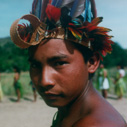
80 % of the world’s biodiversity is found on Indigenous lands. The Amazon is home and source of their livelihoods, culture etc. of Indigenous and traditional peoples. Their ways of life change, and become poorer, as the Amazon is destroyed. They become poorer as the Amazon is destroyed. They become ‘poorer’ in many ways: economically, culturally, linguistically and politically, as their ways of life are connected to the environment they depend on. In addition to the 940,000 Indigenous people in the Amazon (Survival International 2000), there are also fisherfolk, rubbertappers, Maroons, Quilombolas, and other traditional peoples who depend on a healthy forest and environment for their survival.
Demarcation of land in Indigenous areas, extractive reserves, and other areas is critical. For example, Indigenous lands make up 20% of the preserved areas in the Brazilian Amazon. On satellite maps, on e can see that Indigenous and traditional; peoples’ lands are some of the only preserved areas, effectively barring encroachment of unfettered development such as mining, logging, ranching and deforestation.
What are the major threats to the rainforest?
Uncontrolled extraction, logging, road development and infrastructure projects (roads/dams etc.) also threaten the people that live in and rely upon the rainforest for their survival.
© - Rainforest Foundation US, Hosted by Macktez.
