



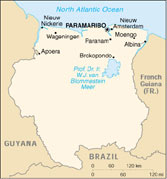

Suriname:
Suriname is a small country located on the north-east coast of South America in a region known as the Guyana Shield. Slightly larger than the state of Georgia, it is home to approximately 460,000 people, 13 % of whom are indigenous or traditional people. All of these ethnic groups claim ancestral territory in the densely forested interior of the country, but although they comprise a majority of the population in such areas, they have few recognized rights and little or no say in economic development plans which directly threaten their environment and way of life.
The biggest problem currently facing indigenous and traditional peoples in Suriname is finding a way to combat the rampant exploitation of gold and timber reserves in their lands by securing national recognition of their long-term land tenure and other basic human rights. Furthermore, Suriname is the only country in the Western Hemisphere that doesn’t recognize Indigenous rights.
Rainforest Foundation has worked with groups in the country since 1999, supporting a variety of efforts led by Indigenous and maroon communities.
Indigenous peoples and maroons
Suriname is home to 9 distinct Indigenous peoples, of which the largest are the Arawak, Carib, Trio and Wayana - totaling about 20,000 persons. They are spread through some 35 communities throughout the country, and represent 3 – 5 % of the population. The Caribs and Arawaks live on the coast and in the savanna-belt between the coastal area and the rainforest interior, while the Trio and Wayana live in the southern rainforest region. These forests and savannahs continue to support Suriname’s Indigenous peoples.
Six Maroon peoples also live in Suriname, including the Saramaka, N’djuka (or Aucaner), Matawai, Kwinti, Aluku, and Paramaka. About 60,000 persons, they comprise some 15% of the total population. Maroons are the descendants of escaped slaves who fought themselves free and established viable, autonomous communities along the major rivers of Suriname’s rainforest interior in the 17th and 18th centuries. They have maintained a distinct culture based on African and Amerindian traditions.
Background:
Suriname was colonized by the Dutch beginning in the 16th century and was long considered one of the richest countries in the region, primarily due to generous Dutch aid packages and abundant natural resources. In fact, for much of the twentieth century it was the world’s leading producer of the mineral bauxite, which was mined in great quantities along the coast. As a result of this prosperity and economic stability, the government paid little attention to exploring natural resources in the forests, which cover almost 80% of Suriname’s landmass.
That reality changed drastically following Suriname’s independence from the Netherlands in 1975 when the country’s two major sources of income were challenged. First, global bauxite prices were in steady decline, causing a major drop in export revenue. Second, the Dutch decided to temporarily suspend all aid in response to the corrupt and reckless actions of the brutal military dictatorship which had come into power. Desperate to slow inflation and secure new sources of income, government leaders turned their attentions more and more towards the rich natural resources found in the country’s interior.
Throughout the past 20 years, the government has aggressively sought foreign investment in both the timber and gold mining sectors, granting numerous concessions to multinational companies at great expense to the Indigenous and Maroon communities who claim the land in question as their traditional territory. (Maroons are the descendants of escaped African slaves who won their freedom from the Dutch colonial authorities in the 18th century, consider themselves autonomous from Surinamese society and as a result are considered tribal peoples according to international standards). Not only have such groups been forcibly relocated from their homes, they have also been the victims of violent intimidation and a general disregard for basic human rights. Furthermore, environmental degradation resulting from development projects (such as toxic mercury run-off into rivers from mining operations) has threatened their very health and life.
Ironically, although Indigenous peoples and Maroons are the oldest inhabitants of Suriname, the government treats them merely as occupiers of state owned land and has no official policy recognizing their rights and interests. This situation falls well short of internationally prescribed standards for the protection of indigenous rights and has caused much protest and mobilization among both local communities and international organizations like the Rainforest Foundation US.
Suriname also lacks a coherent policy dealing with environmental protection, sustainable development and resource management. Even in cases where legislation does exist, it is virtually impossible to hold violators accountable since there country has no system for enforcement and monitoring.
The Rainforest Foundation-US in Suriname
The RF-US has supported projects in Suriname since 1999. These efforts have primarily focused on the work of two organizations: the Association of Indigenous Village Leaders (VIDS) and the Association of Saramaka Authorities (ASA). (link to partner pages) With VIDS, we have supported a community mapping exercise for the Lower Marowijne River, as well as their fourth Conference in September 2001, and a legal strategy meeting for communities who had mapped their territories. RF-US has also supported the ASA’s work since the beginning, helping them first with start-up costs and later with a community mapping project in the Upper Suriname River. We plan to continue working with these two organizations in the coming years.
Links
The following is a partial list of links of interest:
VIDS/ASA page
FPP
http://forestpeoples.gn.apc.org/index.htm
Mining in Suriname, by Fergus MacKay
www.nautilus.org/enviro/Chap3Suriname.PDF
For general information on Suriname, a website run by the University of Florida: nersp.nerdc.ufl.edu/~arm/suriname.html
More general information:
www.llpoh.org/facts/ns_Suriname.html
The Rights of Indigenous peoples and Maroons in Suriname, by Ellen Rose Kambel and Fergus MacKay (a publication of the International Work Group on Indigenous Affairs).
www.iwgia.org/index2.phtml?sprog=en
Informational documents on the Maroons by historian Richard Price
www.si.edu/maroon/educational_guide/23.htm
www.africana.com/Articles/tt_1052.htm

Project News
Our Projects
- Brazil
- Colombia
- Ecuador
- Guyana
Program Partners
Donate to a Project
- The Rainforest Foundation urgently needs your help to continue in its efforts to protect the peoples of the forests and their traditional home, the rainforest.