



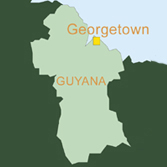

Guyana
The Co-Operative Republic of Guyana is a small country located on the northern coast of South America. Roughly the size of the U.S. state of Idaho, it is bordered by Venezuela to the west, Brazil to the south, and Suriname to the east. Agriculture and mining are Guyana’s most important economic activities, with 70-75 % of export earnings coming from the sale of sugar, rice, bauxite and gold. The country also serves as one of the region’s leading suppliers of ocean shrimp. It’s extremely high debt burden to other countries and multinational lending institutions makes it one of the poorest countries in the western hemisphere.
Due to its colonial history, the population of Guyana is very diverse, with the largest groups being comprised of people of East Indian and African origin. Although Indigenous peoples (known as Amerindians in Guyana) comprise only 6% of the population, they form an ethnic majority in the forested, tropical interior due to the fact that approximately 90% of the general population is concentrated along the coastal plains to the north.
As in neighboring Suriname and Brazil, the largest problems facing Amerindians in Guyana stem from the consistent failure of the government to recognize or protect their basic rights and interests. Without such recognition, Amerindians are powerless to prevent the exploitation of natural resources in their sacred, ancestral territories. Gold mining has been an especially rampant and destructive industry.
Rainforest Foundation US has worked in Guyana since 1996, and currently supports a number of ground-breaking initiatives in collaboration with local organizations. Our strongest allies are the Amerindian People's Association, the most important representative organization of Amerindians in the country, and the Amerindian Legal Services Center, which the RF-US helped found in 1999.
Indigenous peoples
Indigenous peoples in Guyana comprise approximately 8% of the total population, which stands at about 850,000. Amerindians are organised into nine distinct peoples – Arawak, Akawaio, Arecuna, Carib, Macushi, Patamona, Wai Wai, Wapishana and Warrau – whose ancestral territories include the majority of the Northwest coast and the interior, approximately 90 percent of the country.
The Amerindian communities of Guyana have been very active and organized in demanding the recognition of their rights. In addition to lobbying the government for revision of basic legislation, they have filed legal complaints in the country’s high courts, and are now beginning to turn to international remedies.
BACKGROUND
Before the arrival of Europeans, the region was occupied by both Carib and Arawak tribes, who named it Guiana, which means land of many waters. The Dutch settled in Guyana in the 16th century, but their control ended when the British became de facto rulers and renamed the area British Guiana. After the abolition of slavery in 1834, thousands of indentured laborers were brought to Guyana from India, Portugal, China and other far off places, creating the ethnic diversity that defines the population even today. The country achieved independence and became a republic in 1966.
The land and basic human rights of Amerindians, as Indigenous peoples are referred to in Guyana, have been dealt with in a very ad hoc way since colonial times. Though the issue has been discussed and debated throughout the country’s history, little has been done in real terms to protect and recognize their interests. Amerindian rights were first codified under British rule through two Aboriginal Indians Ordinances (in 1902 and 1910), but these pieces of legislation fell short of transferring real title to Amerindians’ ancestral land claims. Rather, the Ordinances created reservations upon which communities could reside but to which they had no official title, essentially making the groups wards of the state. At Independence, it was agreed that Amerindians should be granted more land rights and some measure of political autonomy, and a Commission was created to draft a plan for how to accomplish this. However, to this day, only _ of the titles recommended by the Commission have been granted (through the Amerindian Act of 1976 and various other provisions). Even where titles have been granted, they bear little resemblance to actual Amerindian subsistence practices. Titled lands are often not contiguous, which breaks up hunting and fishing patterns and also facilitates the entrance of destructive economic practices. Titles also don’t include subsoil mineral rights, and often contain provisions allowing the government to change or revoke the terms at any time. No other ethnic group in the country is subject to such restrictions on land ownership. This kind of discrimination and disregard on the part of the government has caused not only disillusionment amongst Amerindian communities, but also real harm and environmental degradation. (this is mostly from Fergus' book on mining in the Mazz- we should probably cite it- and refer people there for further info)
Guyana is one of the most forested countries in the tropics, with over 16 million hectares of rainforests forests, covering roughly 85% of its surface. Such forests contain abundant natural resources including tropical hardwoods, gold and diamond reserves. To ease its great burden of debt, Guyana’s government has increasingly turned to the practice of granting mining and forestry concessions to multinational companies. Though a part of Guyana’s economy since before colonial times on a small scale, those industries have expanded at an alarming and hazardous rate. Mining concessions currently account for roughly 40 % of Guyana’s surface area, and logging concessions an additional 45 %. Unfortunately, most of these concessions abut or overlap with Amerindian ancestral lands in the country’s interior. Amerindians have no legal rights to prevent such concessions, nor are they even notified of the grants in some cases. Even in communities that do hold legal title to their land, poor mapping and demarcation and a general disregard on the part of multinational companies leaves them powerless fend off resource exploration and extraction in their territories.
The adverse effects on Amerindian communities of such economic activities are manifold, including the following: erosion of rivers, disruption of hunting, fishing and farming grounds, water pollution, increased incidence of epidemic diseases, social dislocation and violence and long-term environmental degradation.
The Rainforest Foundation in Guyana
Rainforest Foundation has been supporting work in Guyana since 1996, when we first became familiar with the work of the Amerindian Peoples Association (APA), the country’s main representative Indigenous organization. Since then, we have supported a number of projects, from general assemblies to advocacy work; from self-government workshops to the purchase of solar-powered radios. In 1999, the RF-US actively helped set up the Amerindian Legal Services Center (ALSC) in collaboration with the APA. The ALSC now functions as the legal arm of the APA, and is leading a number of precedent-setting land rights cases on behalf of Amerindian communities in the country.
Links
APA project pages
APA
FPP
http://forestpeoples.gn.apc.org/index.htm
Major Guyanese newspaper
http://www.stabroeknews.com/
General information on Guyana
www.guyana.org

Guyana Projects
-Two-way Radio Project
-Legal Services Center
- Ameridian Peoples Association Partnership Program
Project News
- APA Director wins Goldman Prize
Our Projects
- Brazil
- Colombia
- Ecuador
- Suriname
Program Partners
Donate to a Project