




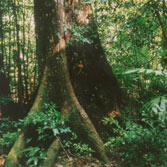

| For years RF-US has supported their struggle - first to fight for their ancestral land and reparations, then to keep their land clear of loggers and ranchers, and now to develop sustainable economic projects. This month, six Panará indians left their village in the Brazilian Amazon for a 19-hour bus odyssey to the nearest city and a frozen plane trip to New York City to assist our work. |
| They arrived to inaugurate this year's Rainforest Awareness Week, one of the central RF-US events to raise awareness about the importance of Amazonian Rainforest and the peoples who traditionally live there. As a forest people who climbed from the brink of extinction to triumphantly return to their traditional home, the Panará embodied the very spirit of the week. |
| RF-US arranged two public appearances for them. First, they performed traditional songs and dances at the screening of a documentary about their plight and victory. Later they participated in a panel discussion co-sponsored by RF-US, the New York University Law School Institute for International Law and Justice, and the NYU Environmental Law Journal. |
| While the Panará delegation originally included both men and women, travel papers can be a problem for indigenous people. As a culture distinct from post-colonial Brazil, indigenous populations uneasily straddle a legal gray area in terms of official state documentation, such as birth certificates and passports. Despite advances to incorporate them as citizens without forcing full assimilation, state documentation can still be a highly bureaucratic and expensive process for a person born in indigenous territory. So, at least this time, no Panará women had the necessary papers to obtain a passport. |
| The New York trip marked the first journey any Panará had traveled outside of Brazil. In the end, we had the privilege to host the first US visit of some of the most respected elders and leaders of the Panará community. Note: they all use their tribe name, "Panará," as a last name- a common practice for traditional cultures in Brazil: |
| Tesséia Panará- Pushing 80 without a single gray hair, this venerable elder came to represent his people and their cause in New York City. Not much of a talker, when Tesséio finally stood to speak, he elicited immediate respect among Panará and New Yorkers alike. | Akâ Panará was chosen by the tribe as a young man to serve as their emissary to the outside world. A natural leader, he negotiated their eventual return home from the Xingu Park reservation where the government had first placed them. Given his years of diplomacy, Akâ is one of the few Panará elders who speaks Portuguese. |
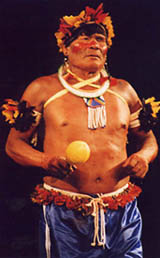 Tesséia Panará |
Akâ Panará |
| Kreton Panará was responsible for much of the group's relations with the Brazilian government as a young man. In New York, Kreton took RF-US Program Coordinator Christine Halvorson on a whirlwind shopping tour to buy bells and maracas for musical accompaniments to the group's dance and song performance | Patikâ Panará, raised on the Xingu reservation, is in charge of promoting his people's traditional culture. He was an eloquent speaker in the panel discussion about the future repercussions of their court victories. |
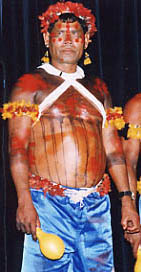 Kreton Panará |
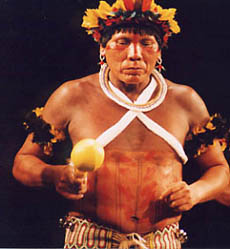 Patikâ Panará |
Paturi and Mikre Panará were the youngest members of the delegation. Trained as a filmmaker, Paturi taped their entire US visit to show back at the village. Mikre is president of the Panará community organization that will adminster the $300,000 reparations payment they should receive this year. Both of them were chosen to serve as translators and intermediaries between the older members of the group and our culture.
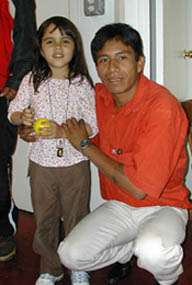 Olivia Leitâo & Paturi Panará |
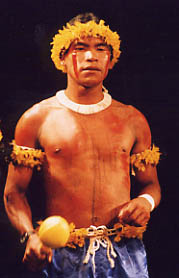 Mikre Panará |
See photographs from the Panará trip to NYC here.
