





|
After almost ten years of court battles, the Brazilian government finally pays reparations to the Panará for near-extinction and a generation of forced exile. Justice can take her time. For the Panará, she waited a full generation to compensate for government policies that nearly destroyed them as an indigenous people. In 1975 the Panará were forcefully airlifted from their traditional land to an indian reservation. This July a village assembly in Panará territory voted how to invest US$420,000 in reparations. 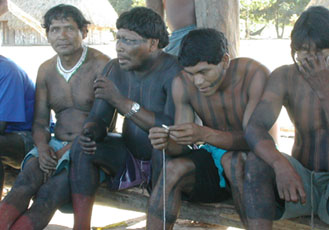 Akâ Panará and other community leaders Their journey from near-extinction to managing an investment fund is the stuff of myth and movies. Long before it was decreed that Progress meant a swath of highway cut through the Amazon rainforest, the Panará were a nomadic people so isolated they existed only in myth to the outside world. Reality arrived suddenly as exposure to infections from construction workers almost nullified their existence. Most of the Panará died of the common cold and diarrhea before the government realized that an ancient culture was about to disappear under the modern highway sprouting on their land. Since 1975, the rainforest grew green over the highway, but the exiles never forgot their ancestral land. In the early 1990s, when the Panará decided to return home, RF-US was there to support their long legal battle. Current RF-US Executive Director Ana Valéria Araújo, along with husband Sergio Leitão, was an original member of the Panará legal team with our partner, the Socio-environmental Institute (ISA). RF-US first provided financial support for ISA's Panará legal defense program in 1996. Since 2000 our programs have worked more directly with ISA and the Panará themselves through our Capacity Building Program. In July, Ana and Sergio with other ISA colleagues traveled deep into Panará territory to celebrate their final victory. Since the first court decision in 1996 recognized their right to the land, the Panará have slowly rebuilt their community. They moved back to the remaining portion of their territory not destroyed in their long absence by gold miners and loggers. They have adapted their traditional lifestyles to a less nomadic, more settled, reality. After centuries of undisturbed tradition, the Panará are now contemplating what the industrialized world means by "sustainable development." With support from the RF-US and ISA, the Panará have created a series of pilot projects for economic alternatives for the long-term future. Since 2000, with the historic legal decision for Brazil's first-ever moral damages awarded to an indigenous people, we have also worked with their community association on administration and financial management. Almost ten years of legal sparring and some training in financial management culminated in July's assembly meeting. The Panará decided to invest the reparations award in a "Panará Support Fund," and use only the interest for the daily needs of the village. Individuals and organizations interested in supporting the Panará can add to the Fund, baptized Kypakre, or "the hole where a turtle hides its eggs." The first nest-egg has already been donated: almost US$42,000 in legal fees, dropped by the lawyers who represented the Panará for all these years. |
